October 20, 2026 | Women's Cross Country, Women's Track & Field
SEATTLE – Straddling a fine line.
In the ever-changing world of college athletics, that's what Maurica Powell often finds herself doing.
But for Powell, the Director of Track & Field and Cross Country and the women's distance coach for the Washington Huskies, perhaps the more accurate term is running a fine line … or hurdling a fine line … or vaulting, jumping or throwing a fine line.
No matter what, Powell's constant pursuit of sustained success with the Huskies means keeping up with and adapting to all of the changes that are happening, while at the same time sticking with some of the approaches that have factored into UW's own success.
"What we're not changing is commitment to academic integrity and bringing in young people and developing them – that's something we're always going to do," she said. "What we've had to change is redefining what success looks like when they're young – that's what has had to evolve.
"It used to be getting to the NCAA Championships could be possible in Year 1. Now, it's going to take two or three years," Powell added. "The NCAA has gotten so competitive – it's like a pro league now."
Powell took a few minutes to talk about how she and the Huskies go about doing things in this still-developing new era and how that has factored some remarkable stories of individual and team accomplishment.
1.You had a chance to spend time in Europe this past summer working with some of your athletes. What were some of the bright spots?
"We've done it a couple summers in a row, trying to provide an opportunity for some of our highest-level athletes to get some international competition and get a taste of the circuit over there. In case they want to continue on as pros down the road, they'll have that experience to build on as they get over there.
"The Molls (pole vaulters Hana and Amanda) were over there competing, and we had a group of middle distance runners compete also. Several were getting ready for the World U20 Championships. We were based in St. Moritz (Switzerland) – a good elevation place – and had races in Ireland and Belgium and Italy."
2. While the men's cross country team started the season with a good amount of experience, there are a lot of newcomers on the women's side. What has been your impression through these first couple months of training and racing?
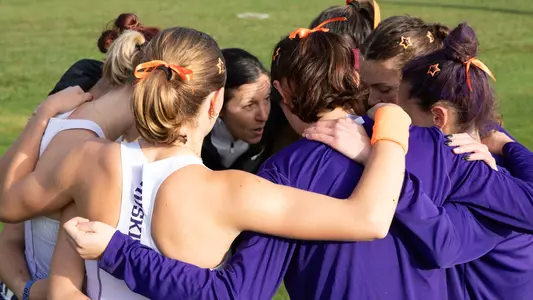
"We have 13 true freshmen for the women, all 17 or 18 years old. Five of them are running in our top 7. This is a group of athletes from all over the world who are really accomplished, really talented – and really young. They're competing pretty routinely against athletes who are 25, 26, 27, and in endurance running, age does matter quite a bit.
"The last few weeks have been about getting that young group a ton of experience, throwing them in the deep end and watching them learn how to compete against a big field of runners. They've trained really hard, and we'll see how they rip it at the end of cross country season. Their trajectory is good, and I expect they'll compete really well at the Big Ten meet."
3. You mentioned "throwing them into the deep end" at the season-opening John McNicholls Invitational on the NCAA nationals course in Terre Haute and then at the Nuttycombe Wisconsin Invitational on the Big Ten course in Madison. Both fields were loaded with nationally ranked teams and your women finished ahead of several of them. What did you see from their performances in those high-caliber meets?
"I went into both of those without any real outcome goals. I just wanted them to have the experience of learning to navigate that size of field and learn how to stay calm and composed. I can't provide them that kind of situation in training. They can get fitter and tougher and better in training, but I can't put them in a situation where they have to navigate 300 people on the starting line. The only solution is repeat exposure.
"We're going to go to these meets, and we want them to try a couple things and don't be afraid to fail. Try to learn something. We're going to take all of September and October to learn and get fitter and put what we learn to use in the postseason over the next month."
4. The Big Ten cross country meet is coming up soon (Oct. 30 at Wisconsin). What kinds of things are you and your athletes focusing on between now and them, knowing that the entire championship season (conference, regionals, nationals) is crammed into a span of three meets in 23 days?
"We're training at a really high level right now. This is the best group of young people I've ever had during my time here (since 2018). Our focus is really on consistent training and getting everybody to keep stringing weeks together and building some mental and emotional resilience to doing hard things.
"For all of these women, they need to understand what the objective is and how they stack the bricks in training to be moving toward those goals and how they stack the bricks emotionally."
5. Along with your new runners, you brought in a very quality new coach in Sadie Van Arkel from national-caliber Northern Arizona as an assistant for the distance runners. What does it mean to you to be able to work alongside someone like that, and how are your athletes already benefitting from her know-how and experience?
"Sadie is fantastic. Northern Arizona has done some impressive things. My friend Mike Smith, who now coaches a pro team, hired her a couple years ago (at Northern Arizona). I remember him telling me that he thought she was fantastic. And as I got to know her, I thought so, too. I haven't had an assistant help me directly with women's middle distance runners before, so this is a new dynamic for me and really productive because our group is twice the size as it was a year ago. She is helping me in a meaningful way."
6. What was it like for you in September when you got word that Hana Moll was the new world No. 1 in the pole vault? And what do you see for both her and Amanda Moll going forward as far as balancing college, looking at a possible fifth year with also setting their sights on the 2028 Olympics?
"Obviously, that's not surprising for Hana. The cool thing for her during that stretch run in August is the way she was competing. She had a start in Lausanne, and the only way she was getting to Zurich (for the next meet) was if she won – and she did. She competed in Zurich and won again, got a spot in the Diamond League final, competed there, and she won. Each time she competed, she really did get a taste for what the pro life is like. It showed she has the chops for this and she's ready for this kind of world."
As for the next steps for the Moll sisters, we haven't really crossed all those bridges. This is their fourth year, they're here and competing here and finishing their business degrees. With the new legislation, it has given them another year of school which they could use if they don't want to change anything going into the Olympics.
"There's a lot of pros and cons to both staying and going. What they've done for our program is pretty extraordinary, so we're going to support them in whatever they want to do. They're smart girls and they'll be motivated to really think this through and decide what's the best thing for both of them. We'll 100 percent support them whatever they do."
7. You have a huge group of track newcomers with 20 freshmen and 10 transfers – a lot of distance kids, but also a mix of pole vaulters, sprinters, hurdlers, and jumpers. Were you looking to have that large of an incoming group?
"We definitely had a directive to increase our numbers pretty substantially, so we did it. We achieved what was assigned. With the women's middle distance and distance, it's a much bigger class than even I expected, even with that objective. It just kind of snowballed. Kids would say, 'Yes,' and they were almost recruiting each other.
"We ended up with a really fantastic new group of freshmen, and also graduate transfers and Ivy transfers – a really nice blend of kids. I couldn't be happier."
8. On the women's side, the Huskies have four individual NCAA outdoor titles in just the past couple of years – one for each of the Molls, the 1500 meters for Sophie O'Sullivan in 2025, and the heptathlon for Sofia Cosculluela last spring. The Molls each have an indoor title, too. The indoor and outdoor teams were both fourth in 2025, and the outdoor team was seventh in 2026. Is this in line with what you envisioned for the program or maybe even better than what you envisioned?
"It's always a goal to be a top-10 team. The ultimate goal is to go get trophies at these things, and to be able to get fourth a couple times was huge for us. To have good performances at Big Tens, these are important things for our program. For us, it's just how to be what it is we're trying to be. The best path for us is to be good in the events that we've been scoring in: the hep, the pole vault, the distances and middle distances, to be able to compete in the 400 hurdles, and we've have pockets of javelin throwers who've been fantastic.
"Those are the things we can do really well and we're going to keep doing those things. We've always kind or prided ourselves on (the fact) that maybe we don't have all the bells and whistles, but we have what we need. We've got kids who are scrappy and tough and who are coming here because they want this environment. They want to be really good. We've got to pick and choose where we're going to try to be really good and how to maximize what we have. I think that's what we're doing really well."
9. You competed in the Pac-12, went to school in the Pac-12 and coached in the Pac-12. Then three years ago, everything changes in terms of joining the Big Ten. And of course, there are constant changes going on at the national level. For you both as a coach and as the program director, how have you had to change, in terms of how you recruit, how you build your team, or even how you approach coaching?
"All evolution is determining what you want to change and what you want to stay the same. The thing we're not budging on is that we are being really rigid on having high academic standards here. We want kids who want to be in school, who want a meaningful degree and who want to contribute to that environment.
We want kids who are motivated to be part of the program and want to contribute to a college track team and are invested in the academic community and the whole university. That's what we want."
"We're committed to young people who come out of high school and want to enroll as freshmen. We have a good history with graduate kids and will continue to do that. But we've not lost a lot of kids. Most kids who come to Washington stay for the entire time. We're not going to change how we're doing business on those levels.
And the coaching aspect?
"The outcomes (at NCAAs) are getting to be world-class. It can be that you're making enormous developmental progress, but you're still not winning yet. So having to frame that for athletes so they can embrace their own progress and how much they're improving is part of coaching. It's a really important piece now for what we're doing. You can't just assess performances in terms of wins and losses. You have to assess progress for the sake of progress.
10. Your son Owen is a sophomore distance runner here. Very few college coaches in any sport get to have one of their own children on their team. What has that been like for you?
"It never escapes me how fortunate I am to see my son every day. It was fun watching him develop over the course of this past summer. He had a bad fall in the 1500 at the World U20 meet (at Eugene in August) so had to refocus and run a 3000 and find a way to be successful in that event, and he was (10th place). I'm proud of the way he showed some resilience and kind of came out on the other side of it. I'm excited for him going into this track season."

Tuesday, August 11
Wednesday, July 08
Wednesday, July 08
Friday, June 12


