The First But Not The Last
April 08, 2026 | Women's Tennis
SEATTLE – She had the results. She had the ranking.
Now, more than 50 years later …
… Trish Bostrom has the recognition.
On March 29, the women's athletics trailblazer, who played top-caliber tennis for the University of Washington in the early 1970s while at the same time helping to force open the door of opportunity for more female athletes just like her, was officially accorded All-American status for her on-court accomplishments
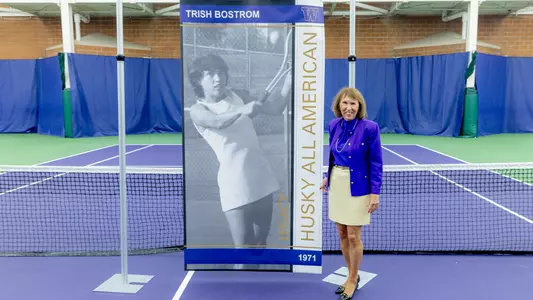
That Sunday afternoon inside the Conibear Shellhouse, Bostrom was presented with a Legacy Intercollegiate Tennis Association All-American award. As part of the ceremony, a banner of Bostrom was formally unveiled. It features a photo of her following through on a forehand, with her name in white on a purple strip across the top and gold letters spelling out "Husky All-American" down the right side.
It will hang in the Nordstrom Tennis Center alongside those of Washington's seven other All-American women and nine All-American men.
"It was a tremendous celebration" said Bostrom, now 74. "Many past members of the men's and women's teams came, and it was extremely exciting.
"They had been working on this for a while. It had taken so many years, I kind of thought it would never happen," she added.
Bostrom's long-overdue honor was for her performance during the 1971 Association of Intercollegiate Athletics for Women national championships. (The AIAW was the governing organization for women's national events from 1971-82, after which the NCAA took charge.) She reached the singles quarterfinals of that tournament in Las Cruces, New Mexico, and also was ranked among the top 20 nationally.
Now, her name will be alongside seven other Husky women's ITA All-Americans, the first of whom was Kristina Kraszewski in 1998 and the most recent of whom was Stacey Fung in 2018.
"When she competed, there were no women's All-Americans," said Karen Baebler, UW's Associate Athletic Director for Sports Operations. "We had Dick Knight, and he earned All-American (in 1970). He was honored with a banner in Nordstrom after it was built, along with every other All-American. All these years, Trish was not called an All-American or had a banner for 55 years.
"We had talked about it with coaches and administrators through the years, and it didn't seem right, even though Trish was one of the top players in the country," Baebler said. "She went on to have a great pro career. She has done a lot for the sport and for women's athletics even before Title IX."
FINDING THE FUNDS TO PLAY NATIONALS
Having grown up in West Seattle, Bostrom's first foray into athletics was as a swimmer. "Then I watched diving in the Olympics and wanted to be a diver, so I started diving," she said.
One summer, she and other neighborhood kids attended a tennis clinic at nearby Hiawatha Park. Before long, Trish and her father, Al Bostrom, a multiple-time national masters champion handball player who was head of the YMCA in downtown Seattle, would go over to that facility every Sunday night to practice tennis on the indoor handball courts.
"We would hit a hundred forehands, a hundred backhands and a hundred volleys against the wall," Bostrom said of her and Al's weekly trips to the Y. "Then I was fortunate to be in the (Seattle Tennis Club) when I was about 16 and they built indoor courts. The men would hit with me, and that increased the level of my game so I could play top-level tennis."
Bostrom always figured she would attend UW to earn her undergraduate degree in political science and eventually pursue her dream of law school.
Tennis was as much a part of her plans as academics, She established herself as the top player for the Huskies, as well as one of the top players on the West Coast and indeed in the entire country. That earned her the opportunity to compete in the 1971 AIAW nationals.
Here's where the irony seeps into the picture: While it was her performance in that tournament (reaching the quarterfinals) that ultimately factored into the unveiling of her long-awaited banner a two weekends ago, Bostrom almost didn't get to make the trip to New Mexico to play in it.
"I knew I had to play in the national collegiate championships in order to improve my game," she said.
Unable to secure school funding to go (this was about a year prior to the 1972 passage of Title IX, which mandated equal opportunity for both genders), she reached out to the local business community.
One of her stops was at Osborn & Ulland, the Seattle-based sporting goods company most famous for its preseason ski equipment sale (dubbed "Sniagrab"; the last of its seven stores closed in 1995). She spoke with company president Yosh Nakagawa, "and he said, 'We will help you,'" Bostrom recalled.
That took care of all but $500 of what she would need. Bostrom was a member of Pi Beta Phi Fraternity for Women (often referred to as Pi Phi) and word had gotten out that she wanted to play in the tournament and was still short on funds.
"I came home from class one day, opened my mail, and here was a big white envelope with five $100 bills in it from an anonymous donor," she said. "To this day, I still don't know who that person is. Whoever it is, thank you so very much. Between that donor and Yosh, I went to nationals."
FROM UW TO THE GRAND SLAMS
That was just the start of Bostrom's upward tennis trajectory. In 1972, she won the Pacific-8 Conference singles title, a noteworthy feat because it was typically a player from one of the four California schools (Cal, Stanford, UCLA or USC) who would win it
That same year, she won the AIAW mixed doubles championship with playing partner Janice Metcalf from University of Redlands in California. (For that tournament, mixed doubles was defined as two players from different schools.)
Bostrom completed her political science degree a couple quarters early, graduating magna cum laude in November 1972. Shortly thereafter. she hopped a plane for Australia to begin her pro career.
"My parents always encouraged me to get my education first and then go onto the international circuit. So I did that," Bostrom said.
She eventually played – and won matches – in all four Grand Slam tournaments. Bostrom was especially good in doubles, reaching (at different times) the doubles finals at the Australian Open, semifinals at the French Open, quarterfinals at the U.S. Open and round of 16 at Wimbledon.
Throughout her career, she was ranked as high as No. 5 in the world in doubles and No. 37 in singles. During the 1970s, Bostrom also played in the initial version of World Team Tennis, including a one-year stint with the SeaPort Cascades.
"I loved to run, I loved the eye-hand-ball coordination that you needed, I loved to practice and to try to improve," she said. "When I played really well, I knew I was playing well because my feet were light and I felt like dancing."
Her pro career went much longer than she initially expected.
"My goal was to play for two years then go to law school," she said. "I was fortunate that tennis boomed in the 1970s, and my two years became eight years (1972 to 1980). I realized I could probably go another five years on the circuit and earn enough money to pay my way. Then I thought, 'You won't go back to law school because suddenly, you'll be in your early 30s.' So I thought, 'I'd better switch right now.' So I changed in 1980 and went to law school."
SPEAKING UP – AND BEING HEARD
When she wasn't making an impact on the tennis court, Bostrom was making one seated at a table in a conference room.
In 1972, having connected with Seattle attorney Don Cohan (who, despite a recent injury, was still able to attend the banner unveiling ceremony), Bostrom was one of the first to bring up the issue of inequities between men's and women's athletics at UW. Later that year, Title IX became the law of the land, with full implementation in 1975.
Today, Washington is regarded as one of the top schools in the country for opportunities and resources that it provides to both genders, with Bostrom initially playing a big part in that.
"To have the University of Washington have the tremendous women's athletic programs that they have now, I can say, I think they are equitable on the Division I level," Bostrom said. "I speak wherever people ask me to speak, and I always speak on equity and Title IX and what it has meant to our country and what it has meant to us, both men and women, and how it has made leaders for our country."
Many of those leaders often do some of their best work behind the scenes. Two in particular – Baebler, UW's Associate AD for Sports Operations, and Mary Schutten, who played tennis for the Huskies in the mid 1970s, were primarily responsible for the legwork and research that helped make Bostrom's Legacy ITA All-American award a reality.
"One of the things that was interesting in the process is we needed to provide the ITA with documentation of her collegiate success," Baebler said. "There's this whole history of women's athletics that is kind of lost – nobody kept records (from Bostrom's era). Mary did a bunch of research and ended up finding most of it through newspaper articles."
Schutten was one of the driving forces behind a 2007 event at UW that recognized almost 300 women for their pre-Title IX accomplishments and has a particular passion for researching women's sports history. Although their Husky careers were a few years apart, she and Bostrom are long-time friends.
"I was at a tennis match last spring and I heard Trish talk about the lack of records for All-American," Schutten said. "I thought, 'I'm the person who can do this. I have the time and the desire.' What it takes is contacting libraries and other archivists and I could put that together in newspaper clippings – and they wanted two copies."
Schutten started the research last summer. She spent a few hours a week over the course of about six months, a good amount of that in the UW's Paul Allen Archives ("That's where I could find anything that I actually needed."). She also pursued articles from back issues of the Seattle Times, Seattle Post-Intelligencer, and student newspapers from Washington and the University of New Mexico, saying, "It was a lot of reading – it was like a treasure hunt.
"Most of all, it was really a pleasure to put it all together."
Baebler is a member of the NCAA Tennis Committee. Working with that group and with the ITA, she had back-and-forth conversations with both organizations over the past year to come up with a proper, meaningful solution.
"We can't just call her an All-American. It has to be bestowed upon her by the ITA," Baebler said. "The ITA has to go through their process, as well."
THE FIRST, BUT LIKELY NOT THE LAST
Those conversations eventually led to the Legacy All-American designation, for women who weren't given All-American awards during the era they played college tennis because there were no such awards at that time.
Bostrom – who said she didn't hear about all of Baebler and Schutten's behind-the-scenes work until just a couple weeks before the ceremony – was the first such recipient.
"I'm very grateful and thankful to Mary and Karen for all of this effort," she said. "It took Mary to do all of this hard-nosed research, and it took Karen all of her work to bring it to the ITA and say this injustice should be rectified."
Added Baebler, "We wanted it to be official. It was a really nice way for us to honor her for everything she has done."
Schutten said Bostrom and others from the pre-Title IX years "are the women who made it OK to pursue excellence in athletics and made it OK to move and challenge yourself on the court or on the field or in the pool. It certainly wasn't easy for her. She persevered, and I was a beneficiary. I call her a paradigm shifter."
Bostrom, who in 1987 was the first woman inducted into the Husky Hall of Fame, still picks up a racket -- although these days, it's usually with her left hand "because I've worn down the cartilage on my right wrist."
No matter which hand she uses, whenever she steps onto the court now, she's officially an All-American. While she is the first Legacy player to be honored, she's hoping to have a lot more company from other such players as soon as possible.
"The ripple effect is going to be very huge," Bostrom said. "I've already had the fun of calling my friends who I know reached the quarterfinals and who are pre-Title IX athletes and informing them that they are All-Americans now."
For Trish Bostrom, the chance to make those phone calls is one of the perks that goes along with having recorded the results … racked up the rankings … and, at long last …
… received the recognition.
Now, more than 50 years later …
… Trish Bostrom has the recognition.
On March 29, the women's athletics trailblazer, who played top-caliber tennis for the University of Washington in the early 1970s while at the same time helping to force open the door of opportunity for more female athletes just like her, was officially accorded All-American status for her on-court accomplishments
That Sunday afternoon inside the Conibear Shellhouse, Bostrom was presented with a Legacy Intercollegiate Tennis Association All-American award. As part of the ceremony, a banner of Bostrom was formally unveiled. It features a photo of her following through on a forehand, with her name in white on a purple strip across the top and gold letters spelling out "Husky All-American" down the right side.
It will hang in the Nordstrom Tennis Center alongside those of Washington's seven other All-American women and nine All-American men.
"It was a tremendous celebration" said Bostrom, now 74. "Many past members of the men's and women's teams came, and it was extremely exciting.
"They had been working on this for a while. It had taken so many years, I kind of thought it would never happen," she added.
Bostrom's long-overdue honor was for her performance during the 1971 Association of Intercollegiate Athletics for Women national championships. (The AIAW was the governing organization for women's national events from 1971-82, after which the NCAA took charge.) She reached the singles quarterfinals of that tournament in Las Cruces, New Mexico, and also was ranked among the top 20 nationally.
Now, her name will be alongside seven other Husky women's ITA All-Americans, the first of whom was Kristina Kraszewski in 1998 and the most recent of whom was Stacey Fung in 2018.
"When she competed, there were no women's All-Americans," said Karen Baebler, UW's Associate Athletic Director for Sports Operations. "We had Dick Knight, and he earned All-American (in 1970). He was honored with a banner in Nordstrom after it was built, along with every other All-American. All these years, Trish was not called an All-American or had a banner for 55 years.
"We had talked about it with coaches and administrators through the years, and it didn't seem right, even though Trish was one of the top players in the country," Baebler said. "She went on to have a great pro career. She has done a lot for the sport and for women's athletics even before Title IX."
FINDING THE FUNDS TO PLAY NATIONALS
Having grown up in West Seattle, Bostrom's first foray into athletics was as a swimmer. "Then I watched diving in the Olympics and wanted to be a diver, so I started diving," she said.
One summer, she and other neighborhood kids attended a tennis clinic at nearby Hiawatha Park. Before long, Trish and her father, Al Bostrom, a multiple-time national masters champion handball player who was head of the YMCA in downtown Seattle, would go over to that facility every Sunday night to practice tennis on the indoor handball courts.
"We would hit a hundred forehands, a hundred backhands and a hundred volleys against the wall," Bostrom said of her and Al's weekly trips to the Y. "Then I was fortunate to be in the (Seattle Tennis Club) when I was about 16 and they built indoor courts. The men would hit with me, and that increased the level of my game so I could play top-level tennis."
Bostrom always figured she would attend UW to earn her undergraduate degree in political science and eventually pursue her dream of law school.
Tennis was as much a part of her plans as academics, She established herself as the top player for the Huskies, as well as one of the top players on the West Coast and indeed in the entire country. That earned her the opportunity to compete in the 1971 AIAW nationals.
Here's where the irony seeps into the picture: While it was her performance in that tournament (reaching the quarterfinals) that ultimately factored into the unveiling of her long-awaited banner a two weekends ago, Bostrom almost didn't get to make the trip to New Mexico to play in it.
"I knew I had to play in the national collegiate championships in order to improve my game," she said.
Unable to secure school funding to go (this was about a year prior to the 1972 passage of Title IX, which mandated equal opportunity for both genders), she reached out to the local business community.
One of her stops was at Osborn & Ulland, the Seattle-based sporting goods company most famous for its preseason ski equipment sale (dubbed "Sniagrab"; the last of its seven stores closed in 1995). She spoke with company president Yosh Nakagawa, "and he said, 'We will help you,'" Bostrom recalled.
That took care of all but $500 of what she would need. Bostrom was a member of Pi Beta Phi Fraternity for Women (often referred to as Pi Phi) and word had gotten out that she wanted to play in the tournament and was still short on funds.
"I came home from class one day, opened my mail, and here was a big white envelope with five $100 bills in it from an anonymous donor," she said. "To this day, I still don't know who that person is. Whoever it is, thank you so very much. Between that donor and Yosh, I went to nationals."
FROM UW TO THE GRAND SLAMS
That was just the start of Bostrom's upward tennis trajectory. In 1972, she won the Pacific-8 Conference singles title, a noteworthy feat because it was typically a player from one of the four California schools (Cal, Stanford, UCLA or USC) who would win it
That same year, she won the AIAW mixed doubles championship with playing partner Janice Metcalf from University of Redlands in California. (For that tournament, mixed doubles was defined as two players from different schools.)
Bostrom completed her political science degree a couple quarters early, graduating magna cum laude in November 1972. Shortly thereafter. she hopped a plane for Australia to begin her pro career.
"My parents always encouraged me to get my education first and then go onto the international circuit. So I did that," Bostrom said.
She eventually played – and won matches – in all four Grand Slam tournaments. Bostrom was especially good in doubles, reaching (at different times) the doubles finals at the Australian Open, semifinals at the French Open, quarterfinals at the U.S. Open and round of 16 at Wimbledon.
Throughout her career, she was ranked as high as No. 5 in the world in doubles and No. 37 in singles. During the 1970s, Bostrom also played in the initial version of World Team Tennis, including a one-year stint with the SeaPort Cascades.
"I loved to run, I loved the eye-hand-ball coordination that you needed, I loved to practice and to try to improve," she said. "When I played really well, I knew I was playing well because my feet were light and I felt like dancing."
Her pro career went much longer than she initially expected.
"My goal was to play for two years then go to law school," she said. "I was fortunate that tennis boomed in the 1970s, and my two years became eight years (1972 to 1980). I realized I could probably go another five years on the circuit and earn enough money to pay my way. Then I thought, 'You won't go back to law school because suddenly, you'll be in your early 30s.' So I thought, 'I'd better switch right now.' So I changed in 1980 and went to law school."
SPEAKING UP – AND BEING HEARD
When she wasn't making an impact on the tennis court, Bostrom was making one seated at a table in a conference room.
In 1972, having connected with Seattle attorney Don Cohan (who, despite a recent injury, was still able to attend the banner unveiling ceremony), Bostrom was one of the first to bring up the issue of inequities between men's and women's athletics at UW. Later that year, Title IX became the law of the land, with full implementation in 1975.
Today, Washington is regarded as one of the top schools in the country for opportunities and resources that it provides to both genders, with Bostrom initially playing a big part in that.
"To have the University of Washington have the tremendous women's athletic programs that they have now, I can say, I think they are equitable on the Division I level," Bostrom said. "I speak wherever people ask me to speak, and I always speak on equity and Title IX and what it has meant to our country and what it has meant to us, both men and women, and how it has made leaders for our country."
Many of those leaders often do some of their best work behind the scenes. Two in particular – Baebler, UW's Associate AD for Sports Operations, and Mary Schutten, who played tennis for the Huskies in the mid 1970s, were primarily responsible for the legwork and research that helped make Bostrom's Legacy ITA All-American award a reality.
"One of the things that was interesting in the process is we needed to provide the ITA with documentation of her collegiate success," Baebler said. "There's this whole history of women's athletics that is kind of lost – nobody kept records (from Bostrom's era). Mary did a bunch of research and ended up finding most of it through newspaper articles."
Schutten was one of the driving forces behind a 2007 event at UW that recognized almost 300 women for their pre-Title IX accomplishments and has a particular passion for researching women's sports history. Although their Husky careers were a few years apart, she and Bostrom are long-time friends.
"I was at a tennis match last spring and I heard Trish talk about the lack of records for All-American," Schutten said. "I thought, 'I'm the person who can do this. I have the time and the desire.' What it takes is contacting libraries and other archivists and I could put that together in newspaper clippings – and they wanted two copies."
Schutten started the research last summer. She spent a few hours a week over the course of about six months, a good amount of that in the UW's Paul Allen Archives ("That's where I could find anything that I actually needed."). She also pursued articles from back issues of the Seattle Times, Seattle Post-Intelligencer, and student newspapers from Washington and the University of New Mexico, saying, "It was a lot of reading – it was like a treasure hunt.
"Most of all, it was really a pleasure to put it all together."
Baebler is a member of the NCAA Tennis Committee. Working with that group and with the ITA, she had back-and-forth conversations with both organizations over the past year to come up with a proper, meaningful solution.
"We can't just call her an All-American. It has to be bestowed upon her by the ITA," Baebler said. "The ITA has to go through their process, as well."
THE FIRST, BUT LIKELY NOT THE LAST
Those conversations eventually led to the Legacy All-American designation, for women who weren't given All-American awards during the era they played college tennis because there were no such awards at that time.
Bostrom – who said she didn't hear about all of Baebler and Schutten's behind-the-scenes work until just a couple weeks before the ceremony – was the first such recipient.
"I'm very grateful and thankful to Mary and Karen for all of this effort," she said. "It took Mary to do all of this hard-nosed research, and it took Karen all of her work to bring it to the ITA and say this injustice should be rectified."
Added Baebler, "We wanted it to be official. It was a really nice way for us to honor her for everything she has done."
Schutten said Bostrom and others from the pre-Title IX years "are the women who made it OK to pursue excellence in athletics and made it OK to move and challenge yourself on the court or on the field or in the pool. It certainly wasn't easy for her. She persevered, and I was a beneficiary. I call her a paradigm shifter."
Bostrom, who in 1987 was the first woman inducted into the Husky Hall of Fame, still picks up a racket -- although these days, it's usually with her left hand "because I've worn down the cartilage on my right wrist."
No matter which hand she uses, whenever she steps onto the court now, she's officially an All-American. While she is the first Legacy player to be honored, she's hoping to have a lot more company from other such players as soon as possible.
"The ripple effect is going to be very huge," Bostrom said. "I've already had the fun of calling my friends who I know reached the quarterfinals and who are pre-Title IX athletes and informing them that they are All-Americans now."
For Trish Bostrom, the chance to make those phone calls is one of the perks that goes along with having recorded the results … racked up the rankings … and, at long last …
… received the recognition.
Thursday, July 16
Wednesday, July 08
Wednesday, July 08
Thursday, April 23